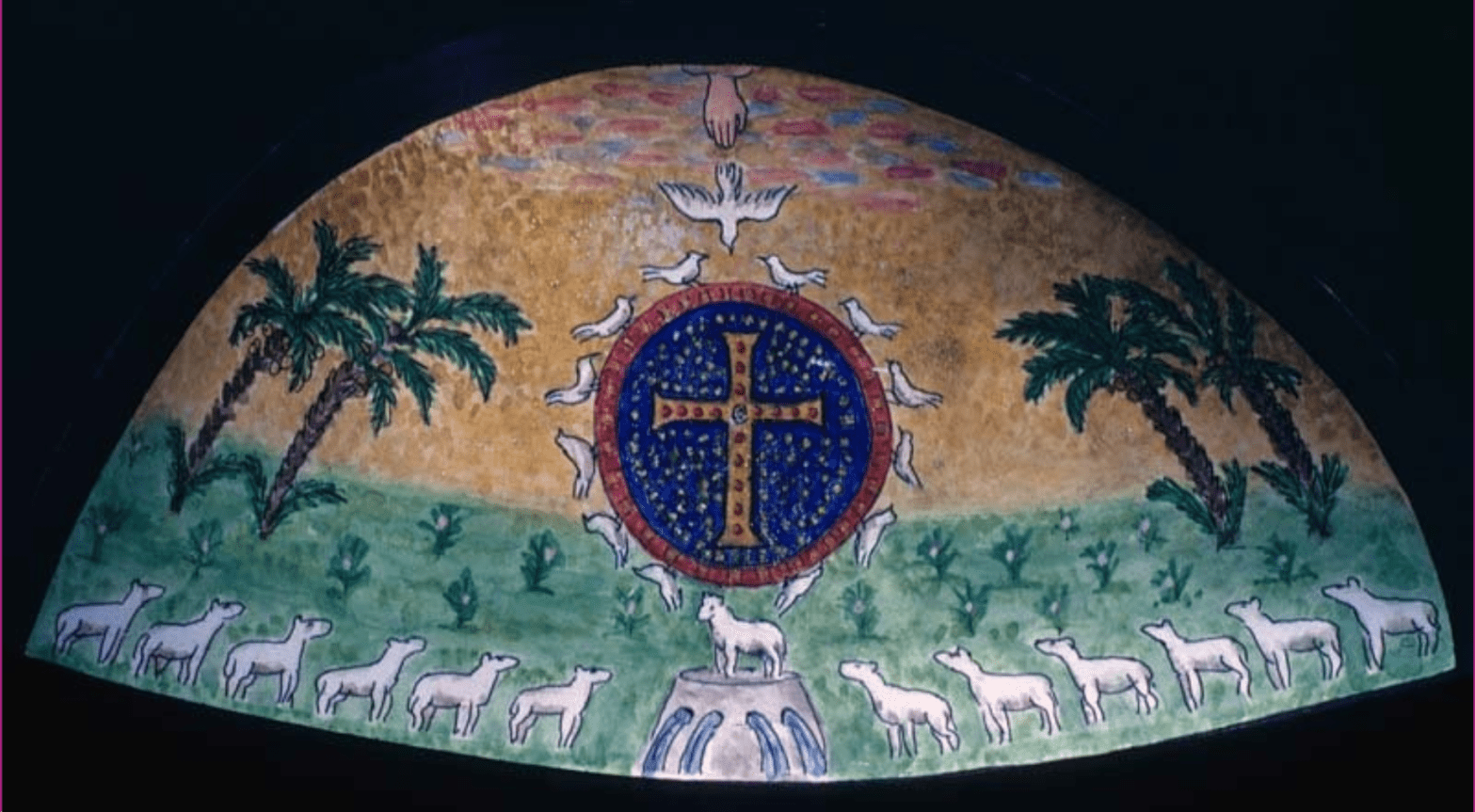
Art is used to express feelings otherwise not felt by only words. I chose the first image of the Holy Trinity from San Clemente, Rome to analyze. I looked over all of them, but the first encompassed my relationship with the Trinity.
This image is bright and full of green. The trees, grass, and plants are green, which symbolize life. The Trinity is “the Lord, the giver of life.” He made all things. The hand represents the Father. He is reaching down from a beautiful sky to give us the gift of his spirit in the form of a white bird. God the Father gives us His spirit to follow his calling to the Promised Land.
The Holy Spirit is represented by this white bird, more commonly referred to as a dove. The Holy Spirit enlightens us with God’s grace. Through the Holy Spirit’s intervention, we are called to serve God and others. We can evangelize and love our neighbors as we love ourselves. The white bird is guiding the beautiful cross symbol to the lamb. The Holy Spirit wants the lamb to take in the gift and teach the message of the cross to all.
The Son is represented by the lamb atop a stone in the center. Jesus is the sacrificial lamb. He gave up his life to save us. It was the ultimate action of mercy and passion. Something I noticed under the lamb is the “living” water flowing out of the rock underneath the lamb of the Son. Last assignment I found an image of Jesus as the living fountain of the Eucharist. This is important, at least to me, because living water has an internal source and never stops flowing. The love of the Trinity pours out onto all of us all of the time. The water is the cause of such green and prosperous land.
Other figures in the image include 12 white birds and 12 lambs. These represent the 12 Apostles and the continuation of Jesus’ ministry. Jesus poured out his teachings to the Apostles who spoke in tongues of fire to the people of the world. The Apostles created the Church we have today. Essentially, we are the birds ready to inspire others and we are the lambs ready to sacrifice and serve God. Also note, there are no human beings or personas in this depiction. I think the absence serves to portray that God’s love is shown through all things: through fertile land, through sacrificial lambs, and beautiful skies.
The other paintings were beautiful, but did not “speak” to me. I did not like the contemporary paintings; they were actually somewhat scary. However, the Eastern European Perichoresis paintings were interesting. Google says that the word ‘perichoresis’ means rotation in Greek. In all of the paintings, human-like figures are arranged in a circle form. The word harmony comes to my mind. These figures are very calm and carryout human actions. Besides the olive tree in one painting, there were really no symbols in the parichoresis images.
These Trinity paintings were all tailored to the communities they served. Each community held and taught a different depiction of the Holy Trinity. For example, image #13 was a Native American man (the Son) reaching to a bird (the Holy Spirit) who is coming down from an elder (the Father). In my understanding of American Indian culture, elders were highly revered. Depicting the Father as an elder was easier for the community to understand that God the Father was to be respected and was all-powerful. Religious art has a lot to tell us, even though it does not use written words. In painting #1, the 3 in 1 Trinity creates a harmonious and fertile land for God’s people.
 Macayle Fuchs
excellent reflection
LikeLike